
1. Purpose
The BHVI Group (BHVI) have this policy in place with the of:
❖ Creating a working environment which is free from unlawful discrimination, harassment, sexual harassment, bullying, vilification and victimisation and where all workplace participants are treated with dignity, courtesy and respect.
❖ Implementing awareness raising strategies to ensure that all workplace participants know their rights and responsibilities. Among other things, this may include training, providing copies of the policy to employees and discussion at meetings.
❖ Ensuring workplace participants are treated fairly on the basis of merit and not on the basis of irrelevant personal characteristics such as their age, sex, race or disability.
❖ Providing information on the procedure for dealing with complaints of harassment, sexual harassment, discrimination, vilification, victimisation and/or bullying if they occur.
❖ Encouraging reporting.
❖ Treating all complaints in a sensitive, fair, timely and discreet manner.
❖ Preventing victimisation or reprisals.
❖ Promoting appropriate standards of conduct at all times.
2. Scope
The scope of this policy covers all employees of BHVI as well as any consultants, secondees, contractors, and students engaged to undertake any work for BHVI. This policy will also apply to any work-related visitor(s) of the employees of BHVI whilst onsite. This policy covers:
- conduct in the workplace and in situations where work is performed away from the workplace.
- conduct in the provision of goods and services to customers and clients.
- all aspects of the employment relationship from recruitment, throughout the period of an employee’s employment (e.g. in the access an employee has to training, promotion, remuneration benefits etc.) to termination.
- all communication including through email, text messaging and social media.
- situations directly connected with employment such as work-related travel, business meetings, and social events such as festive or end of year functions.
- conduct outside of working hours where the employee’s conduct has an adverse impact on the organisation, their colleagues, the employment relationship or the workplace.
Relevant legislation
BHVI and all workforce participants are subject to the relevant legislation applying to discrimination, harassment, sexual harassment, vilification, victimisation and bullying in the workplace, including but not limited to the:
- Fair Work Act 2009 (Cth);
- Sex Discrimination Act 1984 (Cth);
- Age Discrimination Act 2004 (Cth);
- Disability Discrimination Act 1992 (Cth)
- Racial Discrimination Act 1975 (Cth); and
- Anti-Discrimination Act 1977 (NSW).
3. Policy Statement
BHVI is committed to promoting a working environment that is free from unlawful discrimination, harassment, sexual harassment, bullying, vilification, victimisation and adverse action. Behaviour of this kind will not be tolerated under any circumstances and disciplinary action will be taken against any employee who breaches this policy.
To ensure that the organisation can meet this commitment, it requires all workplace participants (including employees and contractors) to treat each other with respect and courtesy in the workplace and refrain from unlawful behaviour.
4. Discrimination and harassment
BHVI will not tolerate unlawful discrimination or harassment in the workplace. Any employee found to have unlawfully discriminated against or harassed another workplace participant (including a customer or client) may be the subject of disciplinary action, which may result in termination of employment. Appropriate action will also be taken where a workplace participant who is not an employee is found to have unlawfully discriminated against or harassed another workplace participant.
5. Individual and vicarious liability
All employees and contractors are responsible for their own behaviour and can be held personally legally liable as individuals for behaviour that is unlawful; including discriminatory, harassing or bullying behaviour. If a court finds that an employee has discriminated against, harassed, vilified, bullied or victimised someone else at work, the court may order the individual employee to pay compensation to the other person or otherwise rectify the behaviour. The penalties for engaging in this behaviour can be extremely significant. Such conduct may also be prohibited by criminal law e.g. sexual harassment.
BHVI is also responsible for ensuring proper standards of behaviour at work and can be held legally liable for all behaviour at work and can also be held vicariously liable for all employees behaviour unless BHVI has taken reasonable steps to prevent an employee or contractor from committing acts of sexual harassment, discrimination, vilification, bullying or victimisation in connection with his or her employment or engagement.
6. Meaning of Discrimination
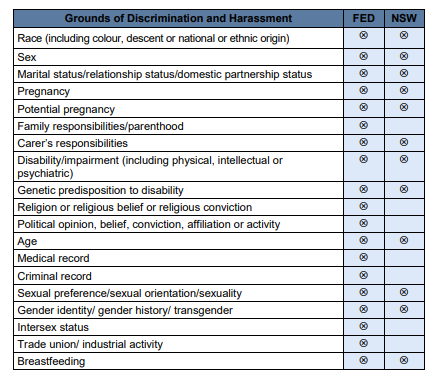
Discrimination occurs when a person or group is treated less favourably than another due to a characteristic that is protected by legislation (Protected Attribute) e.g. age, gender, sexuality, ethnic origin, disability, transgender status, political beliefs, religion or marital status and the other characteristics listed in the table in section 8 below. Unlawful discrimination can occur either directly or indirectly.
Direct discrimination is any action which causes a person, or a group of people a detriment, for example by excluding them from a benefit or opportunity, or significantly reducing their chances of obtaining it because of a Protected Attribute. That is, a person, or group of people are treated less favourably than others on the basis of a Protected Attribute.
Indirect discrimination may occur if the outcome of rules, practices and/or decisions, which appear to treat people equally, actually has an adverse effect on a group of people, or an individual, with a Protected Attribute. Practices may ‘appear’ fair in form but are nevertheless discriminatory in outcome.
An example of indirect discrimination may be a requirement to attend a meeting at a particular time each day e.g. 8am or 3:30pm. This is more likely to impact a person with caring responsibilities (who is also more likely to be female). A person with this Protected Attribute may be required to take children to school or childcare at such times, and there unable to attend this meeting. Even if the ‘requirement’ is not enforced, if the meeting is used to determine how work is allocated or who can access work opportunities, a person with caring responsibilities may be adversely affected and therefore suffer from indirect discrimination. However, the requirement to hold a meeting at a particular time will not be unlawful if the requirement is reasonable in the circumstances.
7. Meaning of Harassment
Harassment is described as any unwelcome or uninvited behaviour (verbal, non-verbal, physical, written or visual) which intimidates, humiliates or offends another person or persons. Harassment on the basis of a Protected Attribute, such as sex, age, marital status, race or disability, is unlawful.
It is important to note that the intention of the person engaging in harassment is irrelevant. What is important is the impact on the person affected and whether a reasonable person would expect that to be the impact on the person impacted, taking into account their personal circumstances.
Harassment can be a single or repeated act.
Legal action for harassment can be taken against workplace participants as individuals. BHVI can also be held vicariously liable for the behaviour of employees and contractors who engage in harassment. There is no requirement that a person being harassed has to advise the person engaging in harassment that their behaviour is unwelcome. However, where appropriate the person being harassed may choose to do so.
8. Grounds of discrimination and harassment
The table below list of the Protected Attributes on which it is unlawful to discriminate against and/or harass others in the workplace, at the time of issuing this policy. This list combines the grounds that apply under Commonwealth and NSW state legislation. Please note that other Protected Attributes may be added to discrimination and/or harassment legislation from time to time.
9. Sexual harassment
BHVI will not tolerate sexual harassment in the workplace, which is a form of harassment. Any employee found to have sexually harassed another workplace participant (including a customer or client) may be the subject of disciplinary action which may result in termination of employment. Appropriate action will also be taken where a workplace participant who is not an employee is found to have sexually harassed another workplace participant.
Sexual harassment is any unwelcome conduct of a sexual nature which has the possibility of intimidating, humiliating or offending another person or persons.
As with other forms of harassment, sexual harassment is against the law and legal action for sexual harassment can be taken against workplace participant as individuals. BHVI can also be held vicariously liable for the behaviour of employees and contractors who engage in sexual harassment.
In relation to allegations of sexual harassment, the intention of the alleged harasser is irrelevant. What is important is whether a reasonable person would have anticipated the possibility that the other person would be offended, humiliated or intimidated by the conduct. Workplace participants may not always realise that the behaviour constitutes sexual harassment, but they must recognise that what is acceptable to one person may not be acceptable to another.
Sexual harassment is not behaviour which is based on mutual attraction, friendship and respect that is invited, consensual or reciprocated.
10. Examples of Sexual Harassment
Sexual harassment may include:
- staring or leering;
- wolf whistling;
- unnecessary familiarity, such as deliberately brushing up against a person, touching, hugging, patting, pinching or fondling;
- suggestive comments or jokes;
- sexually explicit conversation or telephone calls;
- offensive and suggestive body language;
- insults or taunts of a sexual nature;
- unwelcome questions or comments about a person’s sex life, appearance or dress;
- sexual demands, requests for sex or unwanted requests to go out on dates;
- displaying offensive objects, calendars, posters, magazines or screen savers;
- accessing sexually explicit internet sites;
- sending emails or text messages containing inappropriate advances or sexually explicit content;
- inappropriate content sent or posted via a social media site; including inappropriate advances or content of a sexual nature;
- electronically storing, distributing or displaying sexually explicit pictures or videos (e.g. pornographic images or content);
- behaviour that may also be a criminal offence, such as physical assault, indecent exposure, sexual assault, stalking or obscene communications.
11. Vilification
BHVI will not tolerate vilification in the workplace. Any employee found to have engaged in vilification may be the subject of disciplinary action which may result in termination of employment. Appropriate action will also be taken where a workplace participant who is not an employee is found to have engaged in vilification.
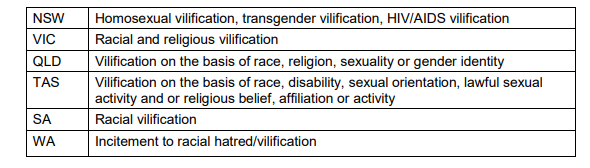
Meaning of vilification – Vilification is a public act which incites, encourages, or urges others to hate, have serious contempt for, or severely ridicule, a person, or group of people because they are (or are thought to be) members of a particular group. Vilification has no justification in “free speech”. Racial vilification is unlawful under the Racial Discrimination Act 1975 (Cth). It includes:
12. Bullying
BHVI will not tolerate bullying in the workplace. Any employee found to have bullied another employee or workplace participant may be the subject of disciplinary action which may result in termination of employment. Appropriate action will also be taken where a workplace participant who is not an employee is found to have bullied another workplace participant.
Meaning of bullying – Workplace bullying is repeated, unreasonable behaviour directed towards an employee, or group of employees, which creates a risk to an employee’s mental or physical health and safety.
Unreasonable behaviour is that which a reasonable person, having regard to all the circumstances, would see as unreasonable, including behaviour that is victimising, humiliating, intimidating or threatening. Risk to health and safety includes risk to the psychological, emotional or physical health of the person.
Repeated behaviour does not necessarily refer to repeated instances of the same type of unreasonable behaviour. A pattern of behaviour involving a series of different types of unreasonable behaviour may constitute bullying.
Bullying can lead to a breach of work health and safety laws, as well as claims under the Fair Work Act. Bullying involving threatened or actual physical violence can also lead to the possibility of criminal charges.
What is not bullying?
• Reasonable management action carried out in a reasonable manner does not amount to workplace bullying.
• Reasonable management action may include:
➢ Allocating work;
➢ Rostering work hours;
➢ Setting performance goals and deadlines;
➢ Giving fair and constructive feedback on an employee’s performance;
➢ Informing an employee about unsatisfactory work performance or inappropriate behaviour;
➢ Restructuring the workplace or other significant change regarding how work is done;
➢ Deciding not to award or provide a promotion, transfer, or benefit in connection with an employee’s employment; or
➢ Action taken in a reasonable manner to demote, discipline, counsel, retrench or dismiss an employee.
13. Victimisation
Victimisation is the term used to describe any adverse impact that a person may be subjected to as a result of making, or assisting with, a complaint. This may include “pay-backs”, retribution or intimidation associated with a discrimination or harassment complaint. Victimisation refers not only to intimidation of the person making a complaint, but also witnesses, supporters and those resolving or investigating any complaints.
There is also legislation which makes it unlawful to victimise someone who has made a complaint relating to bullying.
Workplace participants must not victimise or treat adversely anyone involved in a complaint of discrimination, harassment, sexual harassment or bullying. Employees found to have victimised another employee or workplace participant will be subject to disciplinary processes. Appropriate action will also be taken where a workplace participant who is not an employee is found to have victimised another workplace participant.
14. Responsibilities
It is the responsibility of all workplace participants to:
- Understand and comply with this policy and to seek further information if unclear;
- Comply with the requirements of this policy;
- Treat all workplace participants fairly and with respect;
- Not harass, sexually harass, bully, vilify, victimise or unlawfully discriminate against other workplace participants (including employees, contractors, customers, suppliers);
- Report any incidents of harassment, sexual harassment, bullying, vilification, victimisation or discrimination that they experience or see happening around them to an appropriate manager.
Additional responsibilities of managers
In addition to the individual responsibilities set out above, it is the responsibility of managers to:
- Promote and develop a harassment and discrimination free work environment;
- When recruiting or making decisions about promotion or re-deployment, apply nondiscriminatory screening and interviewing processes;
- When using labour hire or temporary staff, request that agencies apply non-discriminatory screening and interviewing processes;
- Model appropriate behaviour;
- Ensure that all employees who report to them are aware of this policy and the organisation’s expectations that they behave respectfully and tolerantly;
- Know BHVI’s procedures for the resolution of complaints;
- Treat all complaints seriously and follow appropriate procedures for investigating action which may be in breach of this policy;
- Refer complaints to another appropriate person if there is a conflict of interest;
- Monitor the work environment and take immediate action to deal with any behaviour which breaches the organisation’s policies;
- Ensure victimisation does not occur; and
- Take suitable disciplinary action against any person found to have victimised, vilified, harassed, bullied or discriminated against another workplace participant.
It is the responsibility of human resources to:
- Be a point of contact for employees who have concerns about inappropriate behaviour;
- Act impartially if involved in investigating potential breaches of this policy;
- Maintain confidentiality (where possible) and take responsibility for the safe-keeping of confidential documents;
- Assist employees in the resolution of any complaint; and
- Know, assist and advise employees about BHVI’s procedures for the resolution of complaints.
15. Procedure for handling harassment, discrimination and bullying issues
If someone believes that they have been subjected to or have witnessed any conduct that constitutes a potential breach of this policy, then they should raise any concerns in accordance with the processes in the Grievance and Dispute Resolution Procedure. If they do not wish to do so or are unable to do so because the people named in the Grievance and Dispute Resolution Procedure, or for any other reason, they can raise their concern directly with the CEO, or if the CEO is involved in the grievance a member of the Board of Directors.
16. Non-Compliance
Any employee’s non-compliance with this procedure will be subject to BHVI’s disciplinary process which may include disciplinary action up to and including termination of employment.
Any breach of this procedure by a contractor will be dealt with under the relevant contract of engagement and may result in termination of the contract.
As noted above, workplace participants should also be aware that legal action can be taken against them personally if they discriminate against, harass, vilify, sexually harass, bully or victimise another person at work.